It is probably the first real question a couple asks themselves: solo violin, duo, trio or string quartet? The answer is neither a matter of prestige nor of budget — it is a matter of space, of moment, and of intended effect. Here is our reading, after more than ten years of wedding performances.
Before going into detail, one thought to keep in mind: you don't listen to a formation, you listen to a venue dressed by a formation. A string quartet in a tiny chapel will smother the moment. A solo violin on a large seaside terrace will sound timid. The right formation is the one in proper measure to the space.
01 · The intimate, the obvious
Solo violin
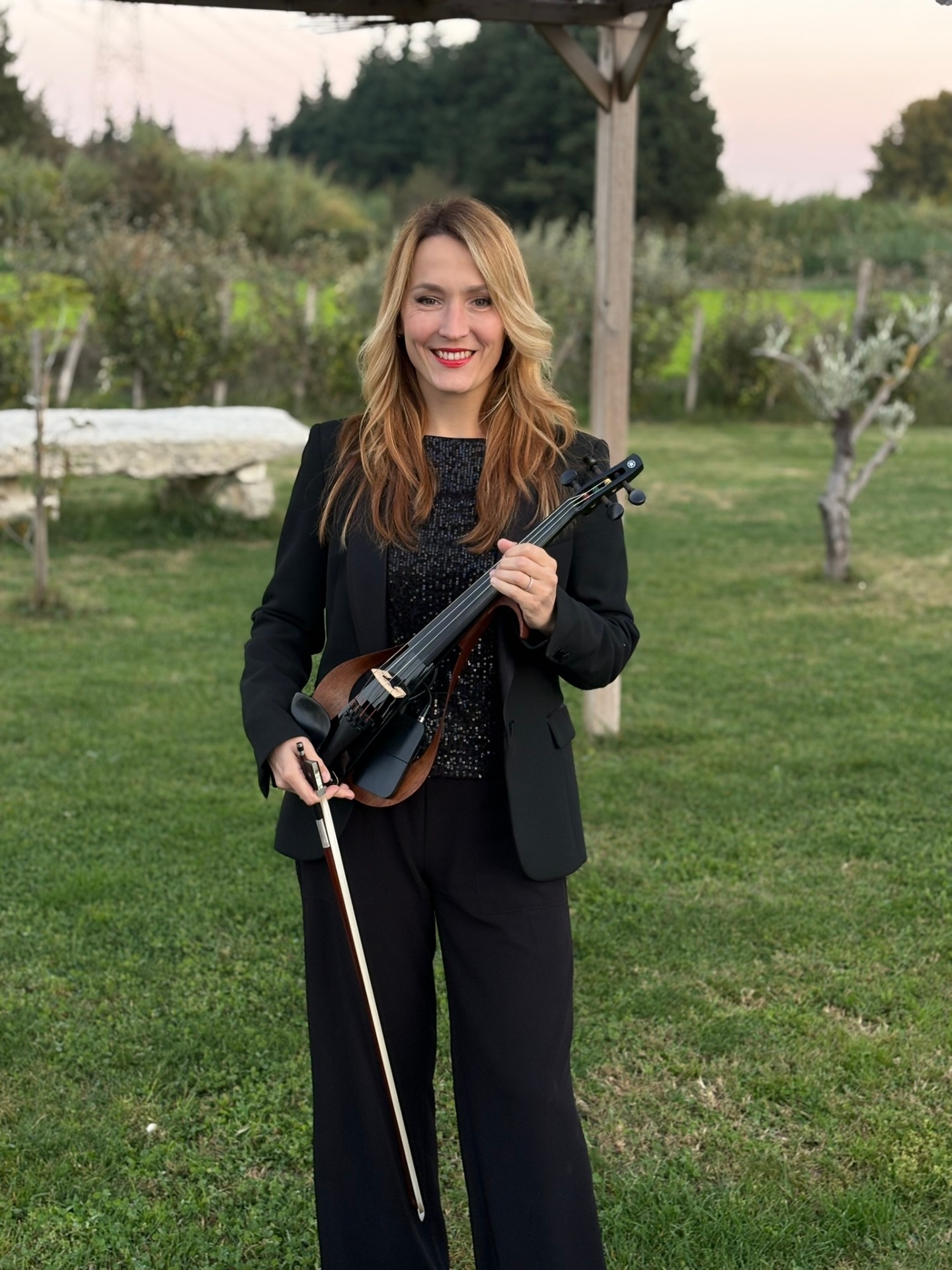
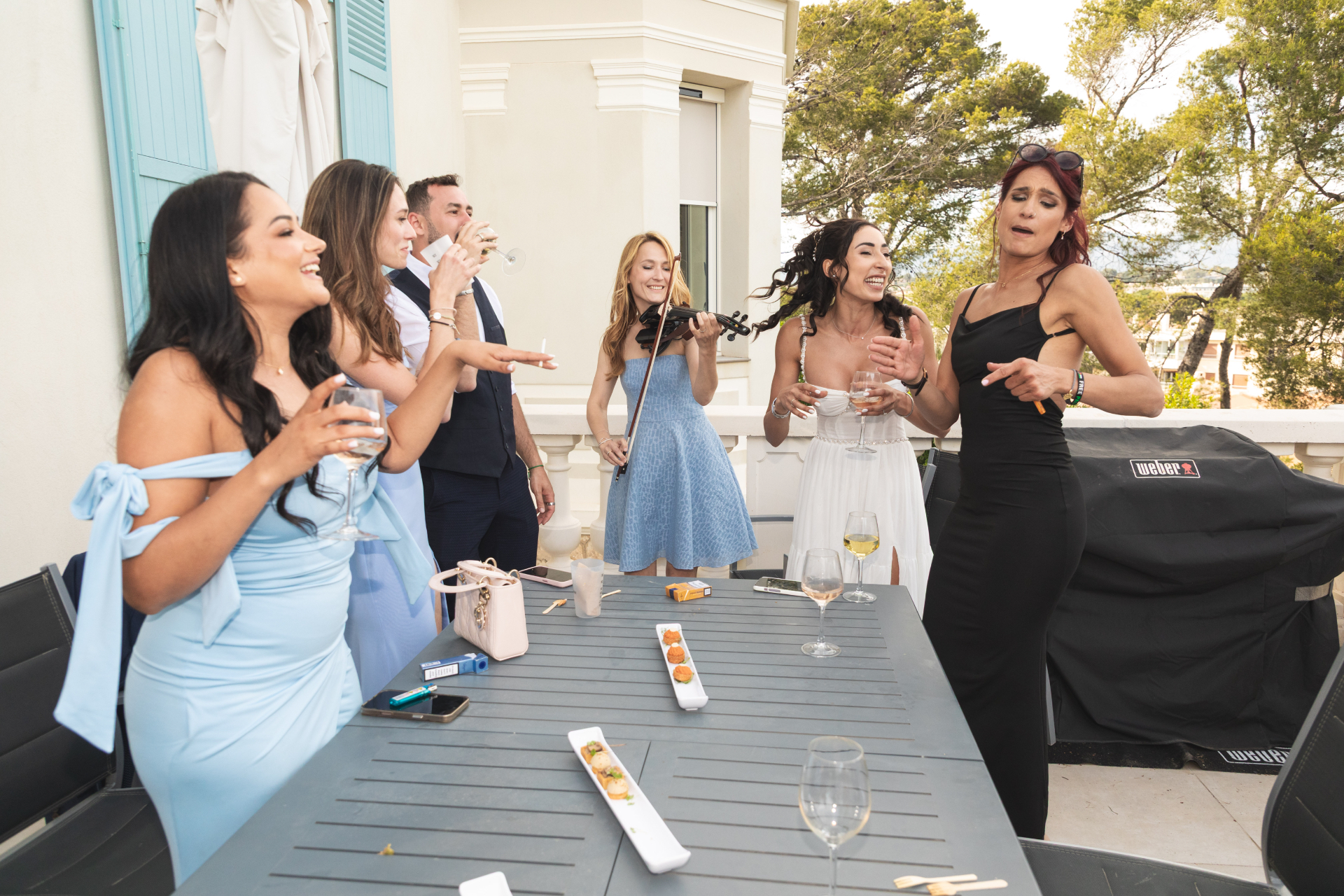
The solo violin is the most expressive option for moments where emotion outweighs staging: a secular ceremony in a garden, a marriage proposal, an intimate cocktail for forty guests. A single voice also means a single gaze — Alina's — who can literally play while walking, follow the couple, approach a moved grandparent. What is lost in sonic density is gained in presence.
Ideal for
Intimate ceremonies (up to 80 guests), marriage proposals, private villa cocktails, chapels, walled gardens.
To avoid
Very large outdoor terraces without amplification, receptions of more than 150 guests where the chatter would cover the instrument.
02 · A conversation between two voices
The duo
The duo is the most subtle format. Two voices in dialogue — violin & cello for warmth and roundness, violin & piano for harmonic finesse, violin & guitar for a more contemporary colour. Our favourite format for receptions of fifty to one hundred guests: ample enough to carry a great piece, intimate enough not to crush the silence of a ceremony.
Ideal for
Medium-sized religious or secular ceremonies, elegant cocktails, weddings in wine estates or boutique hotels.
To avoid
Very large spaces where the absence of a middle voice (the viola) would start to be felt.
03 · The perfect balance
The string trio
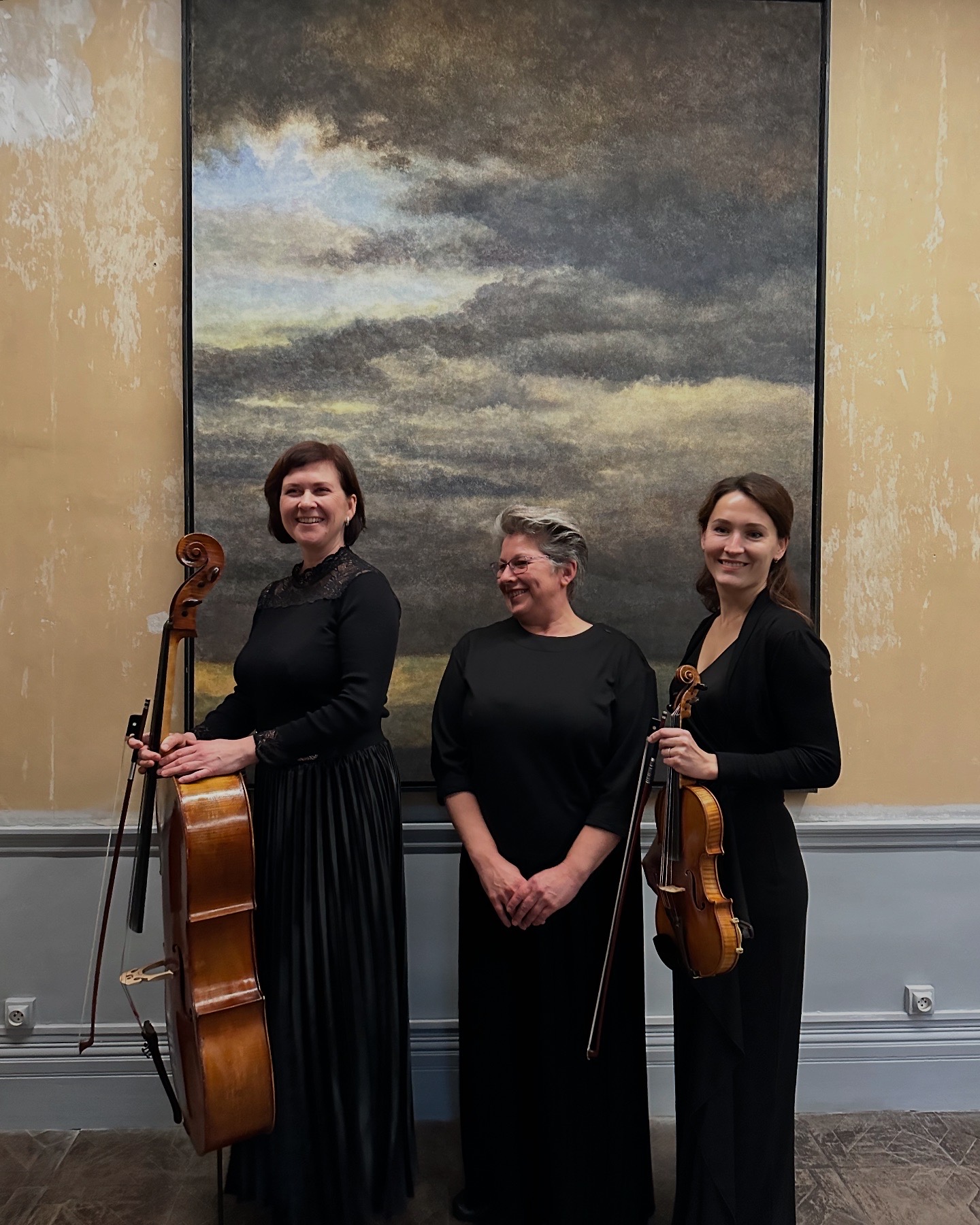
Violin, viola, cello. Three voices, and suddenly the harmony is complete: high, middle, low. The trio is, for us, the best ratio between musical density and visual discretion. It dresses a large terrace without saturating it, carries a cocktail of one hundred and fifty guests without microphone, and opens up a repertoire of a richness the duo cannot reach — Mozart, Schubert, and all of classical chamber music.
Ideal for
Weddings of 80 to 180 guests, large terraces, châteaux and bastides, long outdoor cocktails.
To avoid
Very small enclosed spaces where the density of three strings would be overwhelming.
04 · Assumed grandeur
The string quartet
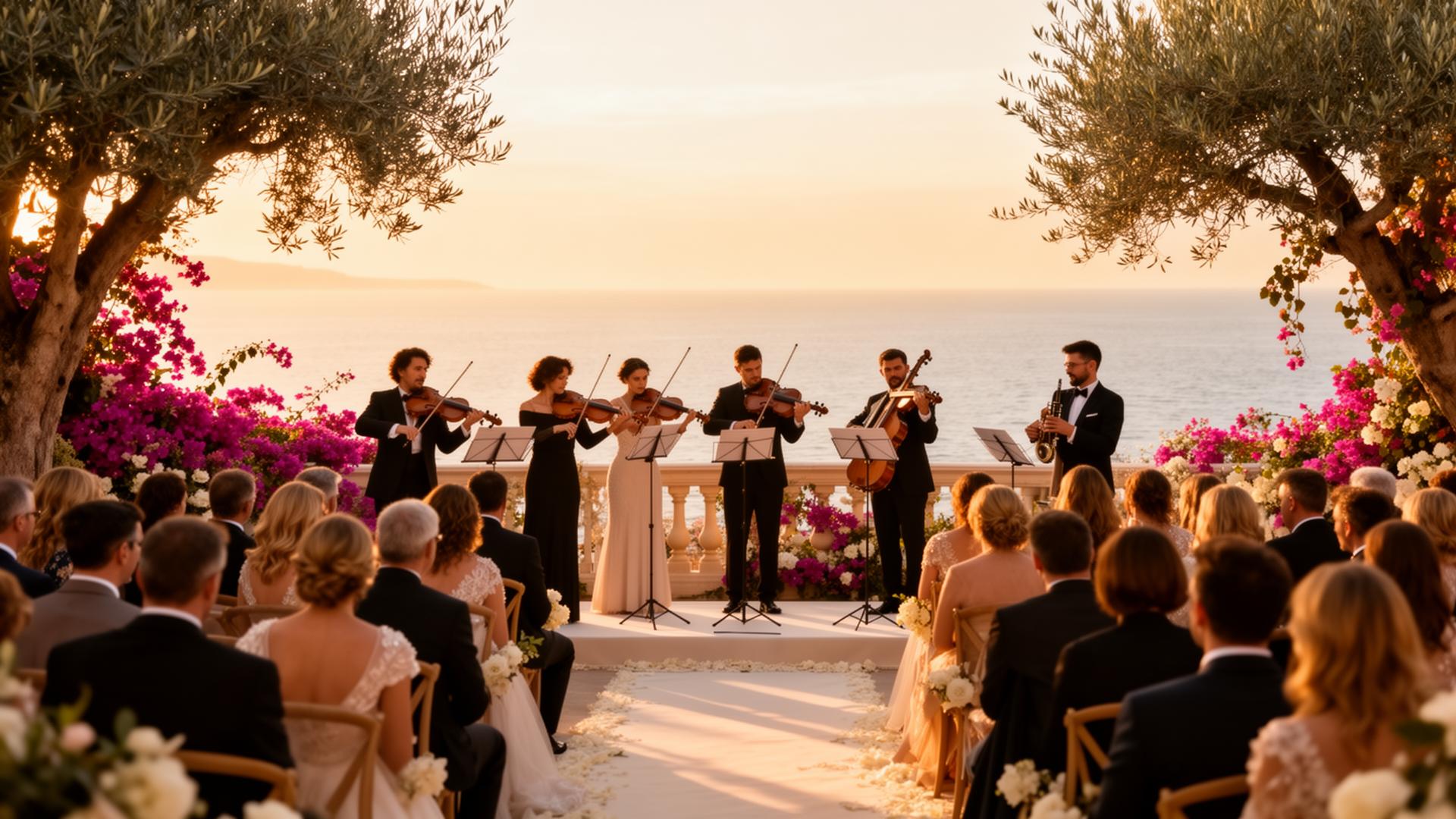
Two violins, a viola, a cello. The royal format of classical music, and the one that imposes itself for grand receptions: more than two hundred guests, palaces, panoramic terraces, theatrical perspectives such as Villa Ephrussi de Rothschild or Eden-Roc. The quartet is not only more powerful — it is more precisely orchestrated. The second violin gives the first a harmonic foundation that transforms the simplest wedding march into a concert piece.
Ideal for
Prestigious weddings of 150 to 400 guests, 5★ palaces, theatrical perspectives, large-scale ceremonies.
To avoid
Intimate private gardens where its power would be disproportionate to the venue.
A simple matrix to decide
If we had to sum up ten years of experience in a few benchmarks: under 50 guests, almost always a solo. From 50 to 100, the duo offers the best musical intimacy. From 100 to 180, the trio imposes itself as the mature choice. Beyond that, and for very large venues, only the quartet matches the space. But these thresholds only hold for standard spaces: a vaulted chapel, a château with resonant salons, a terrace facing the mistral can completely reverse the logic.
And the electric violin?
That is a separate question. Alina's electric violin replaces none of these formations — it complements them. It comes in at sunset, to shift a classical ceremony into a more rhythmic cocktail, or for dancing parties where energy changes nature. Many couples choose an acoustic duo or trio for the ceremony, then Alina alone on electric for the cocktail and early evening.
Our musician's advice
Do not choose a formation because it is more prestigious or more economical. Choose the one that matches your venue, your guest count, and — perhaps most importantly — your temperament. A discreet couple will ring truer with a whispering duo than with an imposing quartet. A flamboyant couple gains by letting the quartet deploy its full breadth. The right musical match is the one that resembles you.
And if you don't know, tell us about your project. In a few exchanges, we will know how to guide you — without overselling.